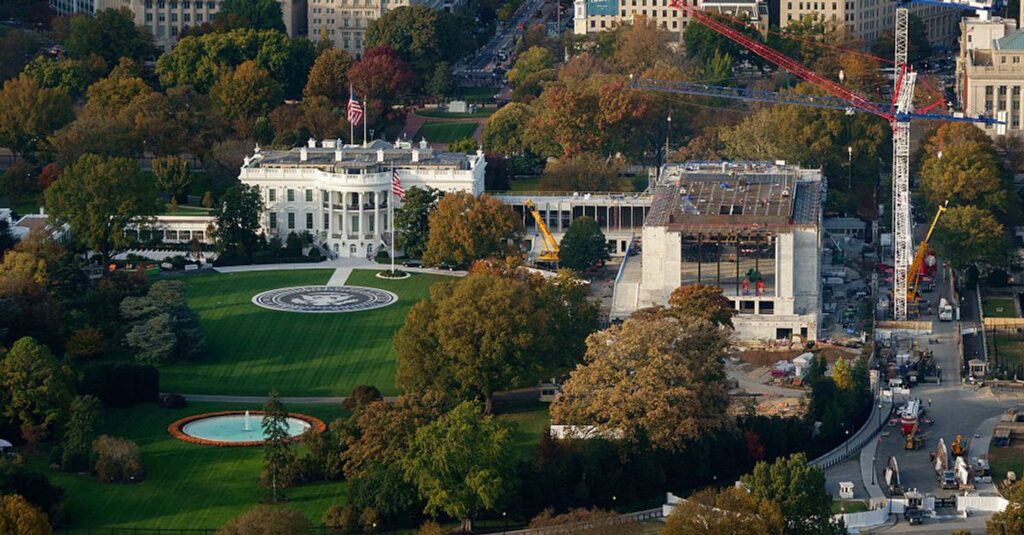
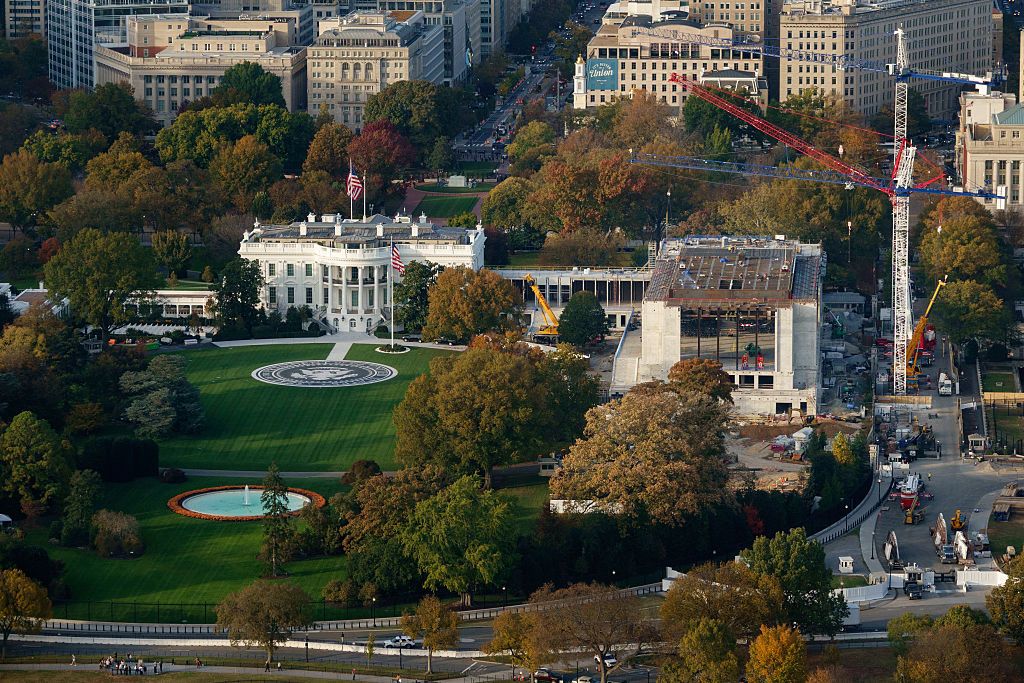
The Trump administration returned to the Supreme Court final week, as soon as once more asking the justices to intervene in its ongoing efforts to construct a brand new White Home ballroom. On Aug. 31, a divided court paused a ruling by a federal decide in Washington, D.C., that might have halted above-ground building on the challenge. In a petition filed on Nov. 5, U.S. Solicitor Normal D. John Sauer requested the courtroom to reverse the decrease courtroom’s ruling outright or to take up the case and listen to oral arguments on the deserves. He advised the justices that their earlier ruling “has all however answered the query offered” by the dispute, and that the challenge “ought to be permitted to maneuver ahead exterior the shadow of judicial superintendence.”
Development on the challenge started in October of final 12 months with the demolition of the East Wing. In December, the National Trust for Historic Preservation – a personal nonprofit that describes itself as having “led the motion to avoid wasting America’s historic locations” “[f]or greater than 75 years” – filed a lawsuit in federal courtroom, searching for to dam the development till the National Capital Planning Commission and the Commission of Fine Arts may evaluation the plans for the development; the NCPC may approve these plans; and Congress may authorize the development.
To help its argument that it had a authorized proper to sue, generally known as standing, the belief submitted a declaration from Alison Hoagland, a member who lives in Washington, D.C., and stated that she visits the world the place the White Home is situated roughly as soon as per 30 days. Hoagland, who has “experience in historic structure,” claimed that the challenge brought about “‘accidents’ to her ‘aesthetic, cultural, and historic pursuits’ as a result of she finds the ‘scale,’ ‘peak,’ and ‘massing’ of the federal government’s design distasteful.”
Senior U.S. District Decide Leon issued an order in late March that quickly barred the development of the ballroom above floor however allowed underground building – of, for instance, bomb shelters and bunkers – to maneuver ahead, together with any above-ground building vital for security and safety.
Earlier than Leon’s ruling may go into impact, the U.S. Court docket of Appeals for the District of Columbia Circuit froze it to provide that courtroom time to think about the federal government’s attraction. In August, a divided three-judge panel of the D.C. Circuit upheld Leon’s ruling however delayed its efficient date for 14 days to permit the federal authorities to go to the Supreme Court docket.
Writing for almost all, Judges Patricia Millett and Bradley Garcia emphasised that Congress, and solely Congress, has the ability “to manage the development and demolition of White Home buildings,” nevertheless it has not accepted any cash for the ballroom building.
In her dissent, Decide Neomi Rao contended (amongst different issues) that the belief didn’t have a authorized proper to deliver a lawsuit, generally known as standing, to attempt to cease the ballroom building.
Calling Leon’s ruling “extraordinary and illegal,” the Trump administration came to the court on its interim docket on Aug. 13. Sauer asked the justices to quickly pause Leon’s ruling, telling them that it might “halt the continuing building of the built-in army advanced, together with a completely safe ballroom area, on the East Wing of the White Home, which is vitally required by nationwide safety.” He argued that the belief lacks standing to sue, as a result of its claims relaxation on a member’s “dislike” for the brand new building – which, it stated, just isn’t the type of harm that might permit the lawsuit to go ahead.
On Aug. 21, the day that Leon’s order was scheduled to enter impact, Chief Justice John Roberts issued an administrative keep – that’s, an order that saved Leon’s order on maintain (and permitted building to proceed) – to provide the justices further time to think about the federal government’s request.
By a vote of 5-4, the courtroom on Aug. 31 granted the federal government’s software and continued the pause on Leon’s order. In an eight-page, unsigned opinion, the bulk harassed that it was not deciding whether or not the challenge was authorized. As a substitute, it stated, the belief doubtless lacks standing to problem the challenge in any respect. The harms that Hoagland alleges, the bulk wrote, usually are not the type of “concrete” and particular accidents required to deliver a lawsuit. Furthermore, the bulk stated, if Leon’s order have been allowed to enter impact, the federal government can be completely harmed – one other key criterion in figuring out whether or not to grant emergency aid. Amongst different issues, it famous, senior authorities officers “attest[] that developing one thing approximating the peak and mass of the meant above-ground ballroom is ‘essential’ to the safety of the below-ground army set up.”
Roberts dissented, in an opinion joined by Justices Sonia Sotomayor, Elena Kagan, and Ketanji Brown Jackson. In his view, the development “is probably going illegal,” and the bulk’s determination was “no victory for the separation of powers.” He contended that the belief did have standing to sue as a result of “[a] historic preservationist comparable to Hoagland may be aesthetically injured in a concrete, particularized method by the transformation of a historic constructing that she ceaselessly enjoys, simply as,” based mostly on prior courtroom precedent, “an environmentalist can maintain a concrete, particularized aesthetic harm from the extinction of a selected animal or the transformation of a selected forest or river that he usually enjoys.”
In its Nov. 5 petition, the Trump administration argued that “the East Wing renovation is a crucial national-security effort happening on the White Home grounds with the President’s private involvement,” and that it has “proceeded swiftly since building started in October 2025, consistent with the urgency of remedying the East Wing’s out of date and weak safety infrastructure, all as this President faces an onslaught of assassination makes an attempt.” As a result of Leon’s order blocked the challenge “on the behest of a single passerby who complains that she expects to dislike its final design,” Sauer wrote, his “determination is demonstrably flawed.”
Sauer acknowledged that the courtroom’s Aug. 31 ruling got here on the interim docket and due to this fact “solely contain[d] a preliminary take a look at the deserves and equities” of the dispute. However, he continued, on this case “[t]right here is nothing additional or new that this Court docket must resolve after its” earlier opinion “so as to reply the query offered” by the federal government’s new submitting – particularly, whether or not Leon was unsuitable to dam “the continuing renovation of the East Wing of the White Home.” That is very true, Sauer recommended, given the courtroom made its Aug. 31 determination “after intensive briefing, and challenge[d] detailed majority and dissenting opinions addressing” the problems within the case.
Sauer urged the courtroom to summarily reverse Leon’s determination – that’s, to reverse it with out further briefing or oral argument – or, at a minimal, grant evaluation and listen to oral arguments.
The belief’s response to the federal government’s petition is at present due on Dec. 7.