
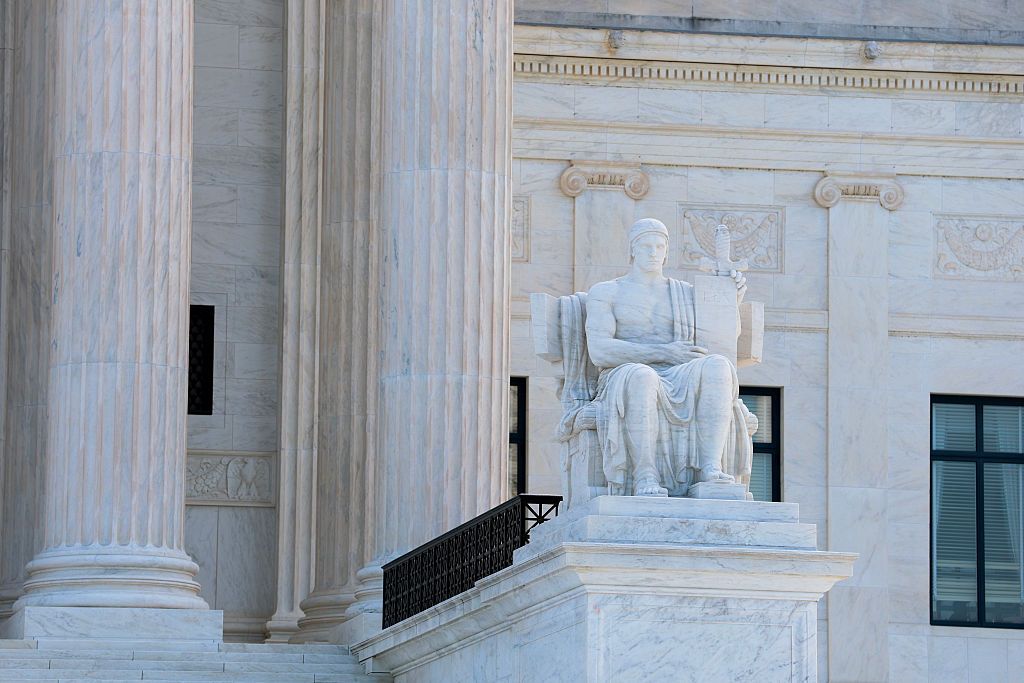
The Supreme Court docket on Wednesday heard argument in Guerrero v. Johnson, a case about whether or not a Texas man on loss of life row can convey a second federal post-conviction problem to his sentence by arguing that, beneath up to date psychiatric requirements, he was discovered intellectually disabled and subsequently can’t be executed.
Besides in just a few slender circumstances, the Antiterrorism and Effective Death Penalty Act of 1996 bars prisoners from submitting a petition for federal post-conviction aid difficult the grounds for his or her detention when an earlier petition has already been rejected. Certainly one of these exceptions is when such a declare depends on “a brand new rule of constitutional regulation, made retroactive to instances on collateral evaluation by the Supreme Court docket, that was beforehand unavailable.” The opposite is that if info “underlying the [initial] declare” would present “by clear and convincing proof that, however for constitutional error, no cheap truth finder would have discovered the applicant responsible of the underlying offense.”
In 2007, Dexter Johnson was convicted of capital homicide and sentenced to loss of life for his function within the double homicide of 23-year-old Maria Aparece and 17-year-old Huy Ngo. 5 years earlier than his conviction, the Supreme Court docket held in Atkins v. Virginia that executing individuals with mental disabilities violates the Eighth Modification. A protection knowledgeable at Johnson’s trial concluded that, beneath the diagnostic requirements employed on the time, Johnson was not intellectually disabled. Following his conviction, Johnson filed an preliminary habeas petition and invoked Atkins to argue – unsuccessfully – that its protections ought to prolong to individuals with psychological sickness.
In Could 2013, whereas Johnson’s first federal petition was pending, the American Psychiatric Affiliation printed the DSM-5, a brand new version of its diagnostic guide that deemphasized IQ cutoffs. Texas’ highest prison courtroom adopted this in 2018. In 2019, Johnson scored 70 on an IQ check, and an knowledgeable concluded he met the DSM-5’s standards for mental incapacity. Johnson then filed a successive habeas problem within the district courtroom claiming that he couldn’t be executed beneath Atkins. The trial courtroom subsequently dominated that his declare (based mostly on the later diagnostic standards) had been “beforehand unavailable,” and the U.S. Court docket of Appeals for the fifth Circuit affirmed that call. The fifth Circuit denied rehearing, and Texas got here to the Supreme Court docket, which agreed to listen to the case in June.
At oral argument, Texas Solicitor Common William Peterson told the justices that Congress “selected to permit new claims in these purposes solely in restricted circumstances that don’t embody modifications within the diagnostic requirements for mental incapacity.” There isn’t any “new rule” “beforehand unavailable” right here, as a result of Atkins was determined earlier than Johnson “even dedicated his crimes,” Peterson mentioned.
Justice Elena Kagan pressed Peterson on why the DSM “isn’t … a part of the regulation?” She recommended that the DSM-5 successfully created “a sort of Atkins I and an Atkins II” – first, a rule barring the execution of individuals with mental disabilities, adopted by a “substantive commonplace” defining what it means to be intellectually disabled. Kagan later described the Atkins commonplace as akin to a rule with a “huge hole in it” the place “the DSM comes and plugs it in and it turns into a part of the authorized commonplace.”
The justices additional debated what it means for a rule to be “obtainable.” Kagan recommended, based mostly on prior precedent, that one thing is “not obtainable to you” if it makes you “run right into a brick wall.” “[I]f I used to be going to be [previously] laughed out of courtroom,” she mentioned, “then, actually, the rule was unavailable to me.”
Justice Ketanji Brown Jackson instructed Peterson that, as she understood AEDPA, Congress’ “coverage selection was to present people one clear shot at bringing their constitutional claims.” Below Texas’ interpretation, she mentioned, “Mr. Johnson won’t ever get that chance,” which “looks like a very incongruous consequence.”
Justice Sonia Sotomayor, for her half, recommended that the end result ought to activate one thing like ripeness (whether or not a case is sufficiently developed for a courtroom to determine). As she remarked to Peterson, “[i]f what we now have mentioned beneath Atkins is you can not execute somebody who’s mentally ailing, we now have a sure means of figuring out that, and it would not develop into ripe till the DM-5 makes it ripe.”
Justice Brett Kavanaugh requested Peterson whether or not the courtroom “might resolve this case solely on the brand new rule situation with out addressing ‘beforehand unavailable.’” Peterson mentioned it might, however that Texas was asking the courtroom to determine the “beforehand unavailable” query.
On behalf of Johnson, Jeremy Schepers instructed the justices that “existence and availability aren’t the identical factor.” Atkins existed, however Johnson’s declare – based mostly on the change in diagnostic standards – was not beforehand obtainable. When the medical requirements for mental incapacity change, Schepers argued, “the Eighth Modification’s protected class doubtlessly modifications as properly. And in these uncommon circumstances, that may render a rule legally obtainable for the primary time.”
Justice Clarence Thomas was skeptical, asking, “Does Atkins ever cease being a brand new rule?” Schepers responded that Atkins “stays new now.” “What about Marbury v. Madison?” Thomas responded. Justice Amy Coney Barrett famous that when “Alexander Graham Bell invented the phone, that was new.” However “I do not assume anyone would describe the phone as new as we speak.”
Kavanaugh pointed Schepers to a “good friend of the courtroom” brief filed by Louisiana and 21 different states, which argued that as a result of the medical requirements are “always evolving,” Johnson’s place is “a recipe for everlasting Atkins claims and nil finality.” Schepers mentioned that was incorrect, as a result of a state prisoner will get “one alternative to lift any declare,” and “so a prisoner couldn’t increase a second Atkins declare.”
At one level, Justice Samuel Alito requested a couple of future version of the DSM that “makes smaller modifications” that “present a better alternative for fulfillment.” Schepers mentioned that declare would fail beneath the fifth Circuit’s studying, as a result of “[i]t’s solely a query of whether or not the declare had a chance of advantage earlier than.”
Emily Ferguson, an assistant to the U.S. solicitor normal who argued as a “good friend of the courtroom” in assist of Texas, emphasised that it’s “troublesome to think about Congress enacting a regulation that will enable the American Psychiatric Affiliation, with out impartial motion of this Court docket, to create a brand new rule of constitutional regulation.” She additionally famous that the courtroom had made clear “states can be liable for the tactic of figuring out mental incapacity,” and it might then make little “sense for there to be an obtainable successive software anytime the related state had a brand new … supreme courtroom case … or perhaps a state decrease courtroom case that modified the framework that the state was utilizing.”
Alito requested Ferguson whether or not the “Atkins rule” was “that an individual might not be executed if the particular person has an mental incapacity that’s thought to be such by medical professionals,” or if “it’s that an individual might not be executed if the particular person has an mental incapacity that may’t be justified by the acknowledged functions of punishment,” for which “the DSM can be proof however not a part of the usual itself?” Ferguson responded that the “latter formulation captures what … the Atkins Eighth Modification rule was.”
Maybe essentially the most noticeable takeaway from oral argument was how subdued the justices have been. The chief justice didn’t ask any questions, and no justice appeared to take up Johnson’s request in his brief that the courtroom dismiss the case as improvidently granted (that’s, determine that it was a mistake to have agreed to listen to the case within the first place and never resolve it), because the courtroom did final time period in Hamm v. Smith, one other Atkins case.
A choice is anticipated by late June however is more likely to come earlier.