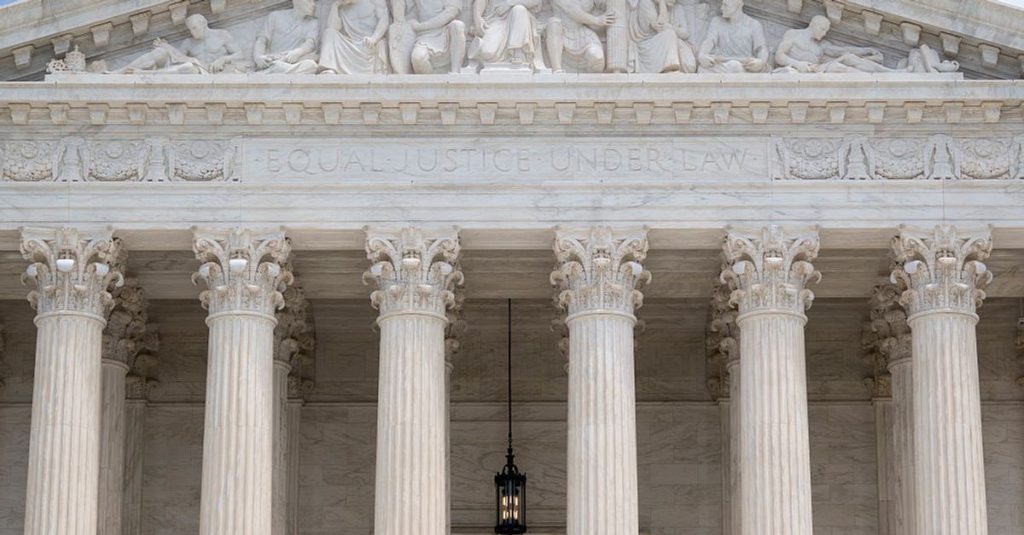
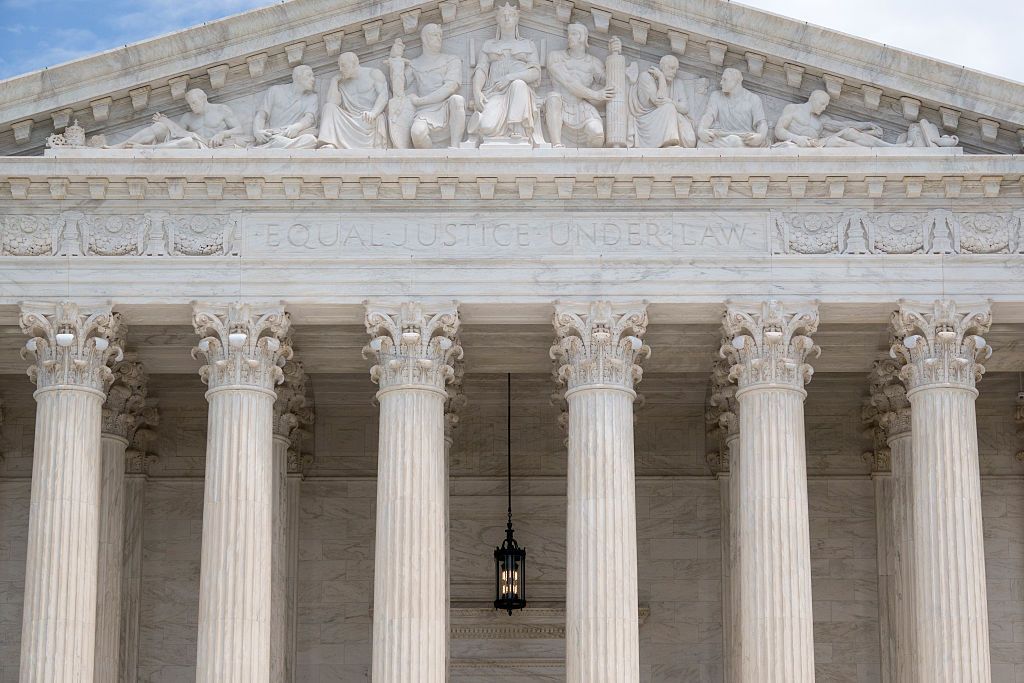
The Supreme Court docket on Monday denied evaluation in a number of notable circumstances, together with a clash between the Trump administration and College of California students over cuts to analysis funding; a California ophthalmologist’s challenge to diversity-related necessities for persevering with medical schooling programs; and a dispute over Maryland’s ban on carrying firearms in “delicate locations.” It additionally invited the US solicitor common to share the federal government’s views on a trio of cases introduced in opposition to the Taliban by victims of terrorist assaults. These denials and requests have been a part of a list of orders from the justices’ personal convention on Friday that was launched on Monday morning.
The court docket beforehand announced, simply after Friday’s convention concluded, that the justices had added two circumstances to this time period’s oral argument docket: Mullin v. Refugee and Immigrant Center for Education and Legal Services, on whether or not the Trump administration can droop entry to asylum for immigrants on the U.S.-Mexico border; and Robinhood Markets, Inc. v. Sodha, on whether or not a financial-services firm violated federal securities legal guidelines when it did not disclose some interim monetary knowledge as a part of its preliminary public providing.
Analysis funding and DEI
The analysis funding case, Trump v. Thakur, stemmed from a collection of govt orders issued by President Donald Trump quickly after he started his second time period, which addressed, amongst different issues, efforts to cut back authorities spending and the withdrawal of presidency assist from “variety, fairness, and inclusion” (DEI) initiatives. Federal businesses responded to the orders by chopping grant funding for initiatives they linked to disfavored subjects, together with DEI, which, in flip, led to lawsuits from states, universities, and particular person students difficult the funding cuts.
Thakur concerned a gaggle of school members and researchers on the College of California who misplaced analysis grants due to the chief orders. They challenged the grant terminations on behalf of a category of different UC students like them, contending that the administration had violated free speech and due course of protections, in addition to the federal regulation governing administrative businesses.
In June 2025, a federal district court docket in California issued a preliminary injunction requiring the Trump administration to reinstate grants for members of two overlapping lessons: 1) UC researchers who have been notified of a grant reduce “by way of a kind termination discover that doesn’t present a grant-specific rationalization for the termination”; and a pair of) UC researchers who misplaced grant funding because of the DEI-related govt orders. The court docket held that cuts affecting the primary group have been prone to be discovered to be “arbitrary and capricious” – that’s, missing good trigger and with out offering a sound purpose – in violation of the federal regulation governing administrative businesses and that cuts affecting the second group have been prone to be discovered to violate the First Modification.
The Trump administration appealed to the U.S. Court docket of Appeals for the ninth Circuit, which initially denied the federal government’s request to place the district court docket’s ruling on maintain. Nevertheless, that very same day, the Supreme Court docket sided with the administration in National Institutes of Health v. American Public Health Association, an interim docket case that additionally addressed analysis funding. A divided Supreme Court docket paused a ruling from a federal court docket in Massachusetts that might have required NIH to pay grants it had moved to terminate, holding that the decrease court docket didn’t have the ability to rule on claims “‘primarily based on’ the research-related grants or to order reduction designed to implement any ‘obligation to pay cash’ pursuant to these grants.” In mild of the Supreme Court docket’s choice, the federal government asked the ninth Circuit to rethink. In an amended order issued in December 2025, the ninth Circuit granted a part of the federal government’s request.
In a May 2026 ruling, the ninth Circuit pointed to the Supreme Court docket choice to elucidate why it was reversing the decrease court docket’s ruling as to the category of researchers who had obtained kind letters from the federal government about their grants. As within the NIH case, the district court docket doubtless lacked the authority to listen to the declare involving that class and to require grant reinstatement, the ninth Circuit concluded.
Nevertheless, the ninth Circuit affirmed the opposite a part of the district court docket’s ruling, agreeing that members of the second class of researchers have been prone to succeed on their declare that ending analysis grants over issues about DEI violated the First Modification. Though “the federal government has discretion to outline subsidy applications in a means that displays its desire to fund (or not fund) specific actions,” the ninth Circuit concluded, the Supreme Court docket has held that, as soon as a subsidy program is established, the federal government “might not discriminate between audio system inside that program to suppress viewpoints with which it disagrees.”
In August, the Trump administration requested the Supreme Court docket to evaluation this second a part of the ninth Circuit’s ruling, contending that it “conflicts with” Supreme Court docket precedent and “additionally interferes with executive-branch priorities in spending taxpayer funds, establishing a harmful precedent that may hamstring each future administration when in search of to subsidize personal initiatives that promote viewpoints aligned with authorities coverage.” The First Modification “doesn’t require taxpayers to proceed funding initiatives that the federal government concludes now not serve the general public curiosity,” asserted U.S. Solicitor Basic D. John Sauer.
Of their brief opposing evaluation, the researchers contended that the case was a poor candidate for evaluation as a result of the ninth Circuit’s choice doesn’t battle with another federal appeals court docket or Supreme Court docket ruling. They additional argued that the Trump administration did not account for the truth that it’s trying to chop off already accepted funds. “[T]he authorities can level to no case the place this Court docket, or any court docket, has held that the President and federal businesses might terminate grants awarded by means of a merit-driven aggressive course of primarily based on the perceived viewpoint of the analysis,” the researchers wrote.
On Monday, the Supreme Court docket denied the Trump administration’s petition with out remark or famous dissent.
DEI and persevering with schooling for docs
Khatibi v. Yip additionally concerned the First Modification and DEI. It was dropped at the Supreme Court docket by a California ophthalmologist, Dr. Azadeh Khatibi, who seeks to problem the requirement, imposed by that state’s Medical Board, that persevering with medical schooling programs embody details about “the understanding of implicit bias” – that’s, unconscious assumptions about individuals from completely different backgrounds.
Khatibi, who often teaches persevering with schooling lessons, and a gaggle of docs went to federal court docket, the place they argued that the requirement violates the First Modification. U.S. District Decide Monica Ramirez Almadani dismissed the case, ruling that the programs are authorities speech and subsequently not topic to the First Modification’s free speech clause.
After the ninth Circuit affirmed Ramirez Almadani’s choice, the doctors came to the Supreme Court docket, asking the justices to take up their case. They argued that Khatibi and different instructors like her “create and ship their very own authentic CME content material with out State drafting, enhancing, project of subjects, or significant oversight.” If the decrease court docket’s ruling is allowed to face, they stated, it “would license states to conscript personal professionals—docs, legal professionals, lecturers, engineers, and others—into advancing contested authorities ideologies at any time when their instruction happens in a licensure-related setting.”
The Medical Board urged the justices to disclaim evaluation. It emphasised that the problem on the coronary heart of the dispute is “slim,” and that the ninth Circuit had “merely held that” the challengers “should abide by the State’s restrictions if they need the programs that they train be eligible for state-approved CME credit score.”
On Monday, the Supreme Court docket denied the petition over objections from three justices. Justice Neil Gorsuch indicated, with out rationalization, that he would grant the petition for evaluation. Justice Clarence Thomas, joined by Justice Samuel Alito, wrote an opinion dissenting from the denial of evaluation, wherein he asserted that the ninth Circuit’s choice in Khatibi’s case “basically misunderstands” Supreme Court docket “precedents and the Structure.” In line with Thomas, “First Modification protections don’t give means just because a State closely regulates speech.”
The Second Modification and “delicate locations”
Thomas additionally wrote an announcement concerning the Supreme Court docket’s choice to disclaim evaluation in Novotny v. Moore, a Second Modification problem to Maryland legal guidelines banning firearms in all kinds of public locations, akin to authorities buildings, college grounds, public transportation, state parks, stadiums, and locations that promote alcohol.
In rejecting the problem to the restrictions, the U.S. Court docket of Appeals for the 4th Circuit relied on the thought, set out within the Supreme Court docket’s 2022 choice in New York State Rifle & Pistol Association v. Bruen, that the proper to hold a gun in public doesn’t apply in “delicate locations.” Of their petition for review, the challengers contended that “[t]he constitutionality of those so-called ‘delicate place’ bans is among the many most important questions dealing with the judiciary within the wake of this Court docket’s choice in” Bruen. They argued that the court docket’s precedent makes clear that though governments might impose some gun restrictions in “delicate locations,” that exception is a “slim” one.
Maryland countered that there is no such thing as a want for the Supreme Court docket to weigh in on this query now as a result of there are “huge areas of shared consensus” among the many decrease courts with regard to restrictions on the place weapons could also be carried and the rationale for such limits. The state pointed to what it characterised as a “[r]ich” historic custom of legal guidelines that “restricted the carrying of firearms in particular places.” The legal guidelines at problem on this case, the state stated, “are in keeping with” these legal guidelines “and the underlying rules of firearm regulation that they embody.”
In his statement, Thomas described himself as “skeptical” of the 4th Circuit’s conclusion that every of the challenged restrictions “‘is in keeping with this Nation’s historic custom of firearm regulation’ in ‘delicate locations.’” However he defined that he agreed with the justices’ choice to disclaim the petition for evaluation, as a result of “the breadth” of the problem to Maryland’s many insurance policies “would complicate” the Supreme Court docket’s consideration of the case. “In an acceptable and extra narrowly centered case, nevertheless,” Thomas continued, “we should always take into account the scope of States’ authority to ban firearms in ‘delicate locations.’”
Different notable denials
The Supreme Court docket denied evaluation in dozens of different circumstances on Monday, together with disputes over how the federal judiciary handles sexual harassment and employment discrimination claims and the Colorado Basic Meeting’s guidelines for referring to transgender or nonbinary people throughout committee hearings.
Strickland v. Moritz concerned a former federal public defender in North Carolina who contends that she was sexually harassed by her supervisor. At problem within the case was the adequacy of the interior system that the federal judiciary requires its workers to make use of for sexual harassment and employment discrimination claims.
Gays Against Groomers v. Garcia was a problem by the nonprofit Gays Towards Groomers, which describes itself as a gaggle of “gays, lesbians, and others locally” who’re against the transgender “agenda,” to the Colorado Basic Meeting’s ban on referring to transgender or nonbinary individuals by the flawed gender or by the title they used earlier than their transition in legislative hearings. The U.S. Court docket of Appeals for the tenth Circuit turned away the lawsuit, holding that “the institution and enforcement of guidelines of decorum for legislative proceedings fall inside the sphere of reliable legislative exercise,” and are subsequently protected by legislative immunity.
And in Custodia Bank v. Federal Reserve Board of Governors, the justices turned down an enchantment introduced by a Wyoming financial institution after the Federal Reserve Financial institution of Kansas turned down its software for an account with that financial institution. The Fed’s choice rested on its conclusion that, as a result of Custodia’s enterprise mannequin was “narrowly centered on crypto-asset actions,” it introduced a higher threat that was “extremely doubtless inconsistent with secure and sound banking practices.” The tenth Circuit sided with the Fed, holding that federal regulation provides the Fed discretion to reject requests to open an account even when the entity making the request is in any other case eligible.
A name for the federal government’s views on terrorism-related circumstances
In its record of orders, the court docket additionally requested the Trump administration to weigh in on trio of circumstances introduced in opposition to the Taliban by victims of the 1998 bombings at U.S. embassies in Kenya and Tanzania, in addition to victims of the Sept. 11, 2001, terrorist assaults. The circumstances got here to the Supreme Court docket in reference to the victims’ efforts to connect or obtain funds from the Afghan central financial institution held on the Federal Reserve Financial institution of New York. The victims’ petitions for review requested the justices to weigh in on how the dedication of whether or not an entity is a “overseas state” for functions of the federal Overseas Sovereign Immunities Act, in addition to the interpretation of the Terrorism Danger Insurance coverage Act, which supplies that when somebody obtains a judgment in opposition to a terrorist group, they’ll acquire funds from the group’s seized or frozen belongings.
The USA has not acknowledged the Taliban as Afghanistan’s official authorities, and the Taliban didn’t file a response to the petitions. As a substitute, a “friend of the court” brief from the top of Afghanistan’s everlasting mission to the United Nations urges the justices to disclaim evaluation. He tells the court docket that he “helps compensation for the Taliban’s victims. However,” he continues, “it can’t come from the Afghan individuals, who haven’t any legal responsibility for the Taliban’s crimes and who resisted the Taliban, at nice price, alongside the US.”
Justice Elena Kagan didn’t take part within the choice to hunt the federal government’s views in two of the three circumstances, indicating that she had recused herself from the consideration of the circumstances due to her prior authorities service – presumably because the U.S. solicitor common in the course of the Obama administration.
There is no such thing as a deadline for the solicitor common to file his briefs.