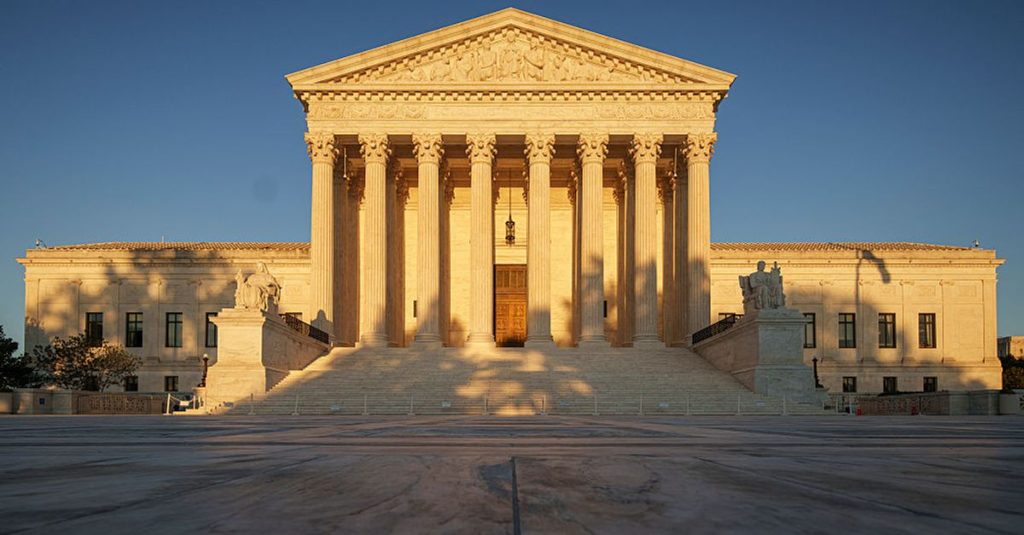
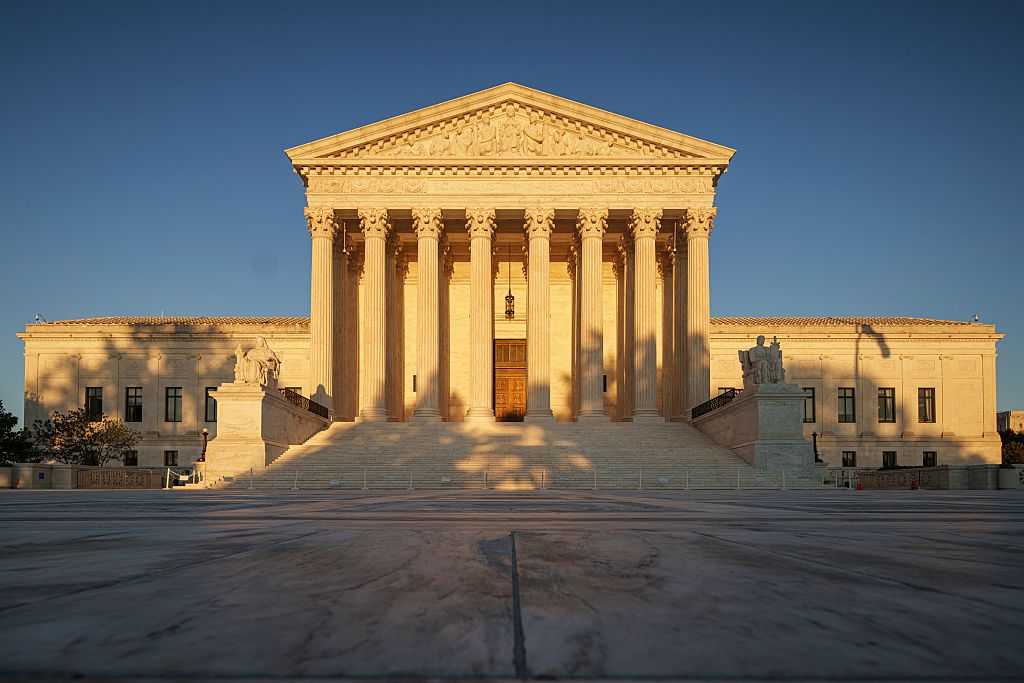
The Supreme Courtroom on Tuesday appeared prepared to carry that the exclusion of Catholic preschools in Colorado from the state’s common preschool program violates the First Modification. After just over two hours of oral argument in St. Mary Catholic Parish v. Roy, a majority appeared to agree with the challengers that Colorado’s refusal to supply them with an exemption from guidelines that will require the preschools to confess all college students – together with LGBTQ youngsters and kids with LGBTQ mother and father – must be topic to a extra stringent constitutional check than that utilized by the decrease courtroom. The courtroom may resolve to use that normal itself or ship the case again to the decrease courts for them to take action.
Colorado launched the common preschool program, which supplies households within the state with as much as 15 hours of free preschool per week at taking part faculties, in 2023. To take part in this system, preschools should meet quite a lot of state requirements and signal a nondiscrimination agreement, by which they consent to “present eligible youngsters an equal alternative to enroll and obtain preschool providers no matter race, ethnicity, non secular affiliation, sexual orientation, gender id, lack of housing, earnings degree, or incapacity.” The preschools can’t decline to serve LGBTQ households, as a result of Colorado believes such refusals would violate the nondiscrimination settlement.
The plaintiffs – the Archdiocese of Denver, two Catholic parishes with preschools (one in all which has since closed), and two mother and father of preschool-aged youngsters – went to federal courtroom to problem the state’s coverage. They contended that requiring Catholic preschools to conform to the nondiscrimination settlement to take part within the common preschool program constitutes illegal non secular discrimination and that the First Modification requires Colorado to carve out a spiritual exemption that permits them to participate in this system.
After each the district courtroom and the U.S. Courtroom of Appeals for the tenth Circuit rejected the challengers’ declare, they got here to the Supreme Courtroom final yr, asking the justices to take up the case – which the courtroom agreed in April 2026 to do.
Representing the challengers, Nicholas Reaves instructed the justices that the faculties within the Archdiocese of Denver “exist to go on the religion to the subsequent technology.” “[T]his just isn’t a zero-sum sport,” he mentioned, as a result of “letting Catholic faculties” take part within the common preschool program “will create extra seats for everybody.”
Representing the state, Colorado Deputy Solicitor Common Helen Norton countered that “Colorado welcomes non secular preschools to” this system and permits them to show their non secular beliefs. It merely asks them, she emphasised, to adjust to the identical guidelines as everybody else.
One of many main factors of rivalry at Tuesday’s argument was the importance of the Supreme Courtroom’s 2022 choice in Carson v. Makin, by which the courtroom struck down a Maine regulation that allowed public funding for use for personal faculties, however not for faculties that present non secular instruction. The case was the third in a trilogy of selections on the supply of public funding for non secular establishments. In Carson, the bulk utilized strict scrutiny – the hardest constitutional check – after it concluded that the Maine regulation barred some non-public faculties from receiving public funds “solely as a result of they’re non secular.”
In response to a query from Justice Clarence Thomas about whether or not a ruling for the challengers would require the courtroom to increase its ruling in Carson, Reaves responded that it might not. In Carson, he insisted, the courtroom’s “focus … was to have a look at … what is going on to the non secular believer?” The courtroom in Carson, he mentioned, “didn’t deal with the textual content of the regulation in Maine. It centered on whether or not faculties are being excluded on account of their non secular train.”
Chief Justice John Roberts pressed Reaves on that time, observing that the regulation at problem in Carson particularly discriminated towards non secular faculties – which, Roberts instructed, just isn’t the case with the Colorado program.
Reaves pushed again. He famous that the legal guidelines in different circumstances involving public advantages had been impartial, reasonably than discriminating towards non secular individuals or organizations – for instance, the courtroom’s 1963 choice in Sherbert v. Verner, reversing a ruling by the South Carolina Supreme Courtroom that had rejected a constitutional problem to the denial of employment advantages from a Seventh-day Adventist whose faith barred her from engaged on Saturday.
Roberts later questioned Norton on a associated level, asking her to distinguish the Colorado program from the regulation at problem in Carson and telling her that the impact of the Maine regulation was “just about the identical because the impact of the regulation right here.” He additionally instructed Norton that the state was making an attempt to “bury Sherbert” despite the fact that “nothing in our precedent has backed away from” it.
Two of the courtroom’s Democratic appointees, nonetheless, echoed Roberts’ preliminary skepticism that Carson dictated the result of the challengers’ case. Justice Elena Kagan instructed Reaves that the trilogy of circumstances culminating in Carson concerned legal guidelines that had excluded non secular establishments and faculties due to their faith. “[I]t was a nondiscrimination precept,” she emphasised, however “you’re asking us to” problem a choice that will go “far past” its earlier circumstances. Specifically, she instructed, the challengers had been looking for a ruling that non secular individuals “want a particular lodging” due to their religion.
Reaves responded that an interpretation of the courtroom’s choice in Carson that centered on whether or not the regulation at problem expressly discriminated towards faith could be “very straightforward to bypass.”
Kagan responded that this isn’t “a superb case to lift the type of specter of circumvention.” “[T]his is a case,” she continued, “of a state making an attempt to implement its personal nondiscrimination ideas.”
Justice Ketanji Brown Jackson appeared to agree. She characterised Carson as a case that prohibited governments from treating non secular faculties worse than it handled secular faculties. That doctrine, she posited, was “fairly slender” and made “excellent sense.” However, she instructed Reaves, “your faculties wish to discriminate by exclusion” when no different college taking part within the common preschool program does so.
A few of the courtroom’s Republican appointees had been extra persuaded by the challengers’ argument – additionally superior by Sarah Harris, the principal deputy solicitor common who argued on behalf of the Trump administration in assist of the challengers – that Carson ought to apply even when the Colorado regulation doesn’t particularly goal faith.
Justice Neil Gorsuch, for instance, requested “what could be left” of circumstances like Sherbert “if every little thing turned on specific discrimination” towards faith, whereas Justice Samuel Alito appeared doubtful that the legislators who enacted the Colorado common preschool regulation “wouldn’t perceive what the impact of” the regulation’s necessities “could be.”
Equally, Justice Amy Coney Barrett requested Norton why, if Colorado can’t expressly exclude non secular faculties from its program, it will probably “impose a situation” – the nondiscrimination requirement – that it is aware of “faculties might be unable to conform to?” Barrett pointed to a New York Times op-ed written within the wake of Carson by regulation professor Aaron Tang, who she acknowledged instructed that states counteract among the results of Carson by enacting nondiscrimination necessities.
Norton resisted any effort to hyperlink Colorado’s nondiscrimination requirement to an intent to focus on non secular faculties, stressing that there was no proof of the legislature’s motives and (in response to a query from Jackson) that the requirement predated the inclusion of spiritual faculties in this system.
The justices and advocates additionally debated, though much less extensively than the importance of Carson, whether or not Colorado’s situations had been impartial and usually utilized to each preschool, no matter faith – the type of authorities actions, the Supreme Courtroom held in 1990 in Employment Division v. Smith, which might be topic to a much less stringent constitutional check, referred to as rational-basis evaluate.
Reaves instructed the justices that the Colorado nondiscrimination requirement was not the type of “across-the-board” prohibition that the courtroom envisioned in Smith as a result of the Colorado regulation accommodates a sequence of preferences to facilitate the matching of households to preschools, together with a “catch-all” desire that permits preschools to request (and the state to grant) a desire not listed within the regulation. Furthermore, he added, the regulation additionally creates exceptions to accommodate youngsters with disabilities and kids from low-income households.
For her half, Norton characterised the preferences as very totally different from the type of exclusion that the challengers search. Even when a college receives a desire, she pressured, it’s nonetheless topic to the nondiscrimination requirement.
Justice Brett Kavanaugh appeared to strategy the case from what he considered a sensible angle, asking Norton why the state wouldn’t “search the win/win?” With over 2,000 preschools taking part within the Colorado program, he mentioned, there must be “loads of alternatives to respect the rights of the non secular believers” and, on the identical time, “the flexibility of LGBT mother and father” to discover a college that may be a good match for his or her households. “Why,” he requested, “has this been provoked?”
Justice Sonia Sotomayor took a special tack, suggesting {that a} ruling for the challengers may have broader implications. A Catholic preschool, she instructed Reaves, may reject a toddler “merely” as a result of his or her mother and father are LGBTQ. Would this, she queried, additionally enable a spiritual preschool to show down Black youngsters?
Reaves mentioned that it might not. He pointed to a 1983 case by which the Supreme Courtroom, making use of strict scrutiny, upheld the Inside Income Service’s choice to revoke the tax-exempt standing of a personal college and personal college with racially discriminatory admissions insurance policies. The federal government in that case, he emphasised, indicated that its curiosity in prohibiting such insurance policies was not merely “compelling” (the primary issue underneath strict scrutiny) however “overriding.”
He instructed the justices that strict scrutiny ought to equally apply to this case. “After which the federal government can come ahead and say we now have a extremely good purpose for” excluding Catholic preschools from this system. However, he concluded, “we simply don’t suppose they’ve performed that on this case.”
By the tip of the argument, Sotomayor appeared to depart little doubt about the place she stood. “It doesn’t matter what line of circumstances we observe,” she mentioned, “there might be great issues and a terrific value to somebody.”
A choice is predicted someday subsequent yr.